


How to make money on marketplace cards: Making Wildberries and Ozon covers stronger and faster with Aidentika
Why a product card affects sales more than it seems
Most buyers make a decision not after a careful study of the characteristics, but much earlier. First, a person sees the product thumbnail, then the main visual of the card, and only then begins to study the details.
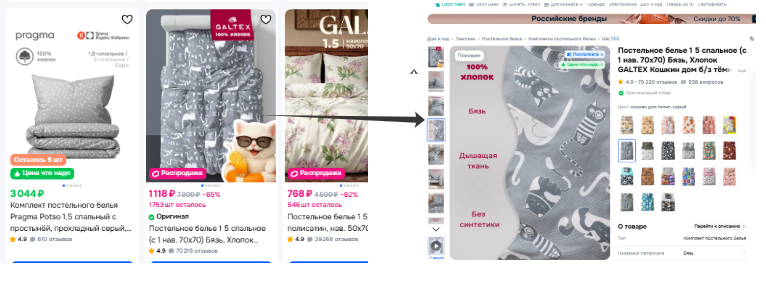
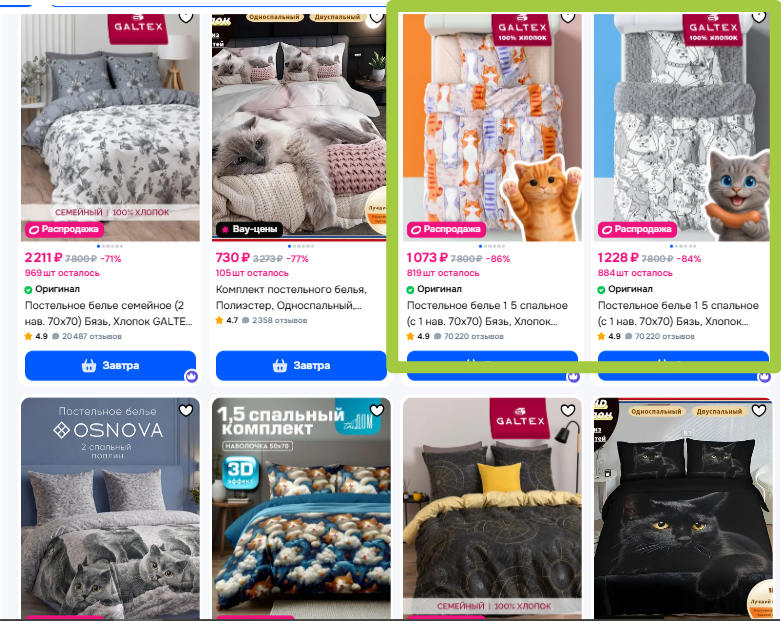
If the image looks boring, overloaded with information, or no different from competitors, the user simply scrolls past it. For example, for the query “Cat bedding”, most products are presented in the same way. But these two options in the right corner are alluring thanks to the cute kittens on the card.
That is why marketers have been studying the impact of visual information on consumer behavior for many years. Research in the field of neuromarketing shows that a significant part of purchasing decisions is made emotionally and largely depends on visual stimuli, which the brain processes much faster than text.
In essence, a product card today performs several functions at once. It must catch the person's eye among dozens of competitors, quickly show the product's advantages, build trust in the brand, and help the buyer imagine the product in their life. This is especially noticeable on marketplaces, where similar products often differ only in presentation. One seller shows a regular photo of the product on a white background, while another demonstrates a usage scenario, benefits, and key characteristics right on the first screens. In most cases, it is the second option that gets more clicks.
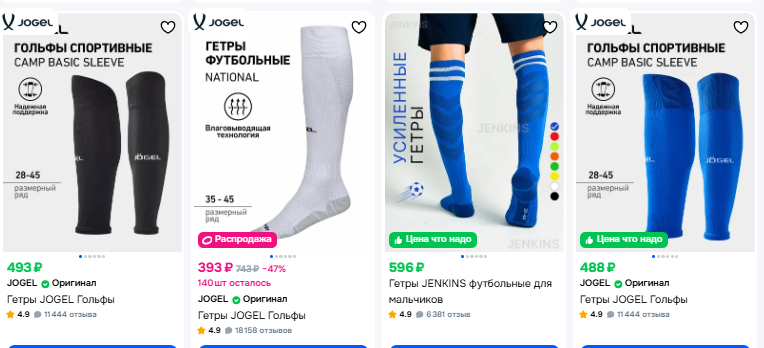
Here is an example for the query "Football socks". Unlike the three cards showing only the socks themselves, the fourth one makes it clear on the very first screen what approximate length they are and that they are reinforced.
That is why a good card designer has long ceased to be just a person who knows how to work in Photoshop. Today, this is a specialist who understands the psychology of the buyer, knows the basics of marketing, and can turn product advantages into visual meanings. This is exactly what sellers are willing to pay good money for. And that is why earning from marketplace cards remains one of the most in-demand directions among designers and content specialists.
How marketplace cards are made manually
Many novice sellers are surprised when they find out how much work is hidden behind a single high-quality product card. From the outside, it seems that the designer just added text to a photo and saved the file. In practice, the process is much more complicated. Before starting work, it is necessary to study competitors, see what visual solutions category leaders use, determine the strengths of the product, and understand how exactly to stand out among hundreds of analogues. This stage alone can take from half an hour to several hours, especially when it comes to a competitive niche.
After the analysis, work with the visual part begins. If the photos were taken independently, the designer has to deal with retouching, background removal, color correction, and preparing source files.
Then the designer creates the card concept, selects fonts, determines the composition, and plans the structure of the future infographics for marketplaces. At this stage, the idea of what the card will look like and which product advantages the buyer will see first is born.
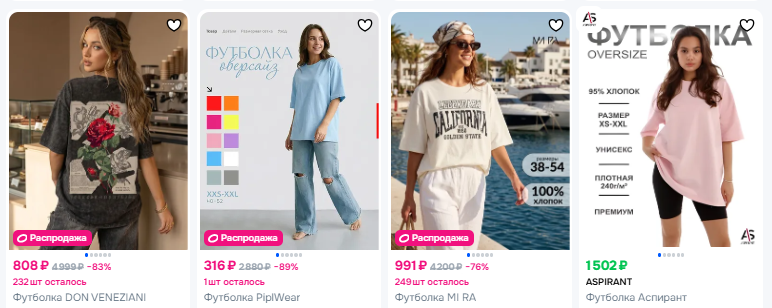
Here is a clear example. A whole row of cards for the query "Women's oversize t-shirt". The product category is the same, but each card has its own advantages, and on some, there are none at all. Which one do you want to open and scroll through?
Next begins the most time-consuming part of the work. Usually, not just one image is created for a single product, but a whole series of images. In addition to the main card, it is necessary to prepare slides with advantages, characteristics, equipment, usage scenarios, and additional arguments in favor of the purchase. As a result, you have to create from five to ten full-fledged images for one product. Even an experienced designer can spend several hours, and sometimes a whole working day, on such work.
A few years ago, the process was even more complicated. To create selling cards, it was necessary to organize photo shoots, look for studios, select models, and pay for the work of photographers. Today, some of these tasks have become easier, but the volume of manual work is still huge. That is why good marketplace specialists are constantly overloaded with orders and are forced to choose between the quality of work and the number of projects.
How much it costs to create a card and whether it is expensive
When a seller receives a commercial offer from a designer, the price often seems too high. However, if you break down the process step by step, it becomes clear where the cost comes from. The client pays not only for the final picture, but also for the time the specialist spends on market research, photo processing, concept creation, and preparing several card options. The more manual work is required, the higher the final price of the project becomes.
Average market rates for creating cards look something like this:
|
Service |
Average cost |
|
Main product card |
from 500 to 2,000 ₽ |
|
Set of 5–7 cards |
from 3,000 to 10,000 ₽ |
|
Premium card design |
from 10,000 to 30,000 ₽ |
|
Full design for a product line |
from 30,000 ₽ and above |
At first glance, the prices look quite reasonable. But the problem begins when a seller has not just one product, but twenty or fifty.
As a result, an interesting situation has formed in the market. On one side are sellers who constantly need new content for marketplaces. They understand the importance of visuals, but do not want to overpay for endless revisions and long turnaround times.
On the other side are designers who would like to focus on creativity and marketing, rather than spending half their workday on routine technical operations. It turns out that both sides are dissatisfied with the same problem — too much manual labor.
This becomes especially noticeable when working with a large assortment. If a seller has several dozen products, the budget for creating cards can amount to hundreds of thousands of rubles. At the same time, a significant part of the expenses is not related to the designer's expertise, but to the fact that many processes are still performed manually, and they require payment for working hours. That is why the market has begun to actively look for ways to automate work with visual content.
How AI is changing the economics of the card market
The last two years have been a turning point for marketplace specialists. The emergence of neural networks has shown that many tasks that used to take hours of work can be completed in a matter of minutes. Today, a neural network for marketplace cards is capable of automatically removing backgrounds, creating product scenes, placing an item in an interior, showing it on a model, or preparing several visualization options for testing. All of this significantly reduces the volume of mechanical work.
>>> You might be interested: we recently talked about how to make money on AI video and create vertical formats that go viral. By the way, video cards could also blow up marketplaces. Think about it <<<
It is important to understand that artificial intelligence does not replace the designer. On the contrary, it makes the specialist stronger. If previously a designer spent most of their time on technical tasks, now they can focus on searching for unconventional ideas, studying the audience, and developing truly strong concepts. In essence, the market is gradually moving toward a model where the quality of marketing thinking is compensated, rather than the number of hours spent at the computer.
For sellers, the changes also turn out to be beneficial. They gain the opportunity to launch new products faster, test different visual options, and reduce content creation costs. Instead of weeks of waiting, some tasks begin to be solved in literally one working day. This is especially important in conditions of high competition, where the speed of launching new cards directly affects sales.
Identika — an example of a new generation of tools for marketplaces
A good example of how the content creation market is changing is the Identika service. Its idea is built not around complex neural network settings and long prompts, but around the practical task of a seller or designer: to quickly get high-quality visuals for a marketplace without unnecessary routine. This is exactly why the service proves interesting to two audiences at once: content specialists and store owners on Wildberries and Ozon.
For a designer, Identika becomes a full-fledged AI assistant. Instead of spending hours cutting out products, looking for suitable scenes, or creating dozens of variations manually, a specialist can get ready-made visual solutions in minutes. Take a simple product photo from a smartphone, choose one of the ready-made presentation concepts, and just type all the data for the infographics into the service — it will arrange all the words beautifully and in their places on its own.
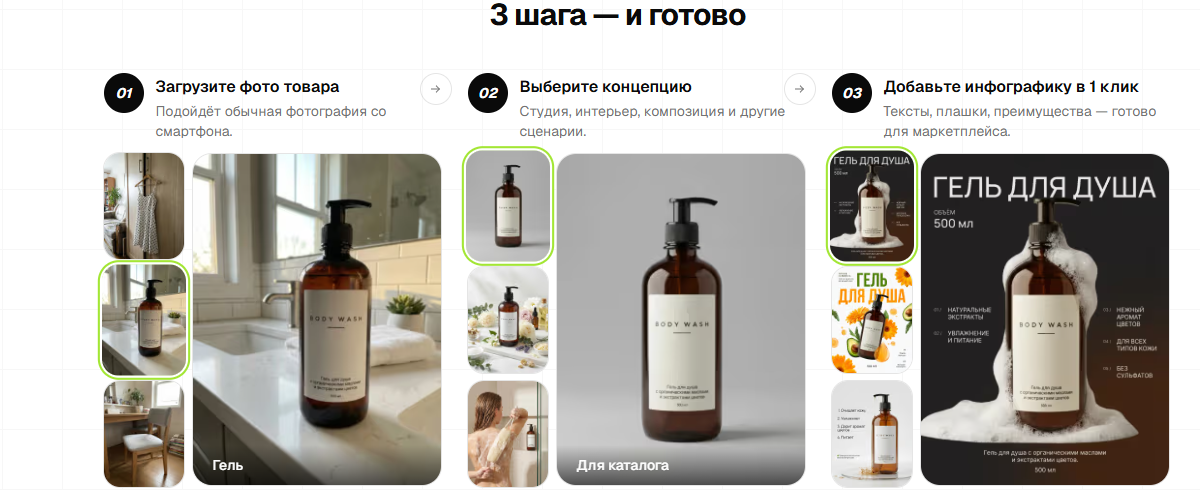
The freed-up time can be spent on developing the concept, analyzing competitors, and searching for creative ideas. As a result, a designer is able to manage more clients simultaneously and increase income without fatigue and burnout.
For a seller, the benefits look different. They get the opportunity to independently create a part of the content without the need to hire contractors for every single task.
And if the work is still handed over to a designer, using modern AI tools allows getting results at the level of expensive studios much faster and cheaper. In essence, Identika helps remove the most expensive component from the process — the routine that previously ate up the time and money of both sides.
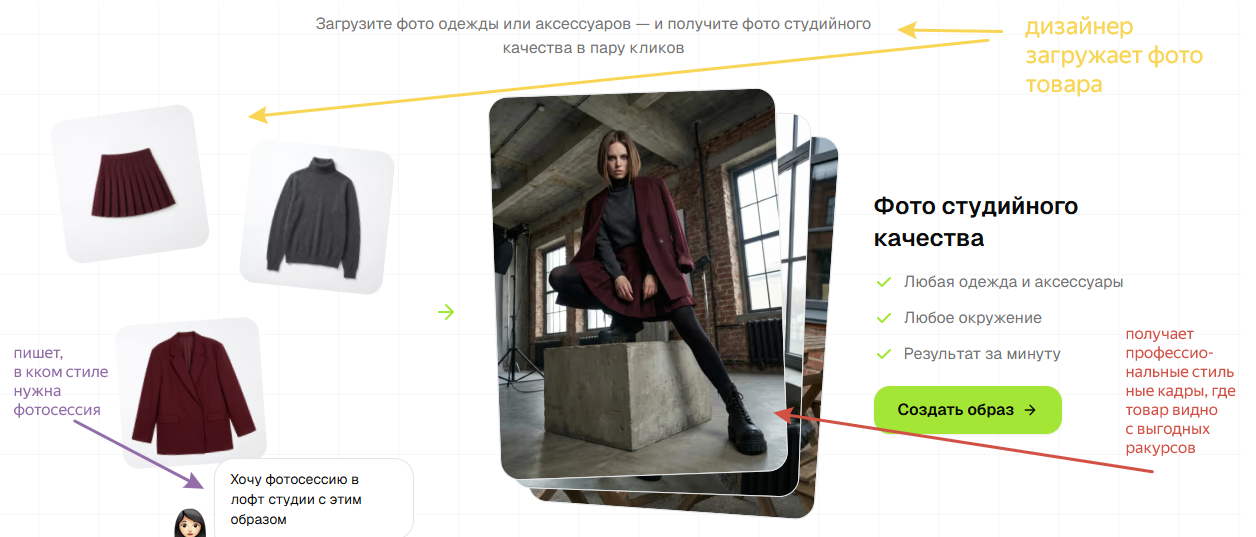
The marketplace market is becoming increasingly competitive, and content quality requirements continue to grow. Therefore, the winners will not be those who do more manual work, but those who learn to effectively use new tools. This is precisely the direction in which the entire industry of creating marketplace cards is developing today.