
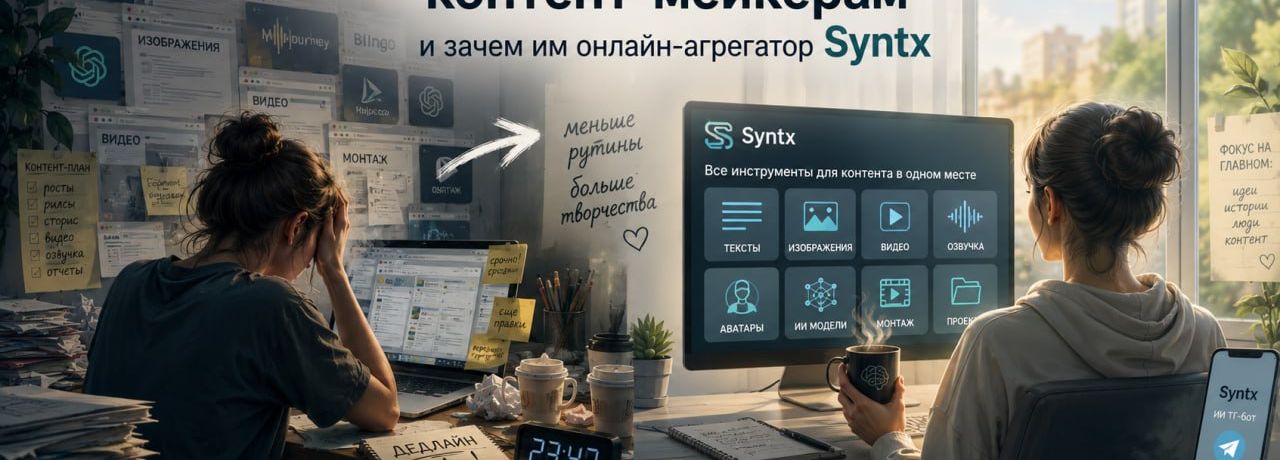
How content creators can overcome burnout and why they need the online aggregator Syntx
One SMM specialist hadn't taken a vacation for almost 10 years. Algorithms changed, deadlines multiplied, content plans grew, and all this time she kept working. But in 2025, something broke. She took three months off, completely disconnected from social media, and realized she didn't want to return to her previous routine. This is what professional burnout looks like today. But why, just five years ago, most marketers and SMM specialists were coping, and now even the most experienced are starting to break down? And how is AI to blame, when it was supposed to make work easier?
What Psychologists Say About Burnout in the Age of AI
When the first generative models appeared, many expected the workload on specialists to decrease. But the opposite happened.
Much more content started being produced. Along with this, expectations from clients, employers, and audiences grew. If a designer used to need to prepare a few visuals per week, now they're expected to produce dozens of images, short videos, adaptations for different platforms, and constant experiments with new formats.
According to Creator Burnout Statistics 2026, between 62% and 90% of active content creators today experience signs of professional burnout. The main reasons cited are algorithmic pressure, the need to constantly produce new content, and overloaded workflows.
Another observation is even more interesting. Snippet's research showed that one of the main causes of burnout wasn't creative tasks at all. Most of the energy is drained by operational work: switching between services, searching for files, approvals, uploads, downloads, and endless process administration. On average, this takes up to 15–20 hours per week.
At the same time, the level of so-called technostress is also rising. A study of Russian specialists, published in the International Research Journal in 2026, confirms the link between digital overload and professional burnout. The more digital tools an employee uses simultaneously, the harder it is for the brain to switch between tasks and maintain concentration. You have to simultaneously remember where the script is stored, which neural network was used for the AI photoshoot, where the video was created, which service handles the AI voice, which editor contains the footage, and what still needs to be sent to the client. Even good to-do lists don't help when the brain is constantly forced to jump between scattered services.
That's why many specialists today aren't looking for a new neural network. They're looking for a way to enjoy their work again.
What an Aggregator Means and Why They Became the Answer to Burnout
Interestingly, AI service developers noticed this problem quite quickly. The first major AI platforms were highly specialized. Some could write texts. Others generated images. Others created videos. Others handled voiceovers. And editing, for a long time, still had to be done manually.
At first, this approach seemed logical. But the more actively the market grew, the more another problem became apparent: specialists had to assemble a single project literally piece by piece.
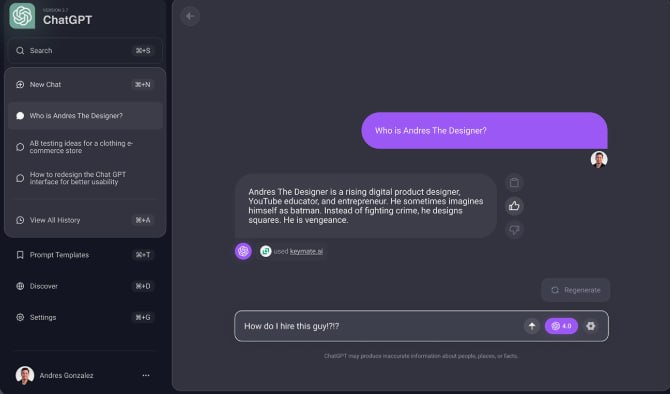
Remember what the first version of Chat GPT looked like:
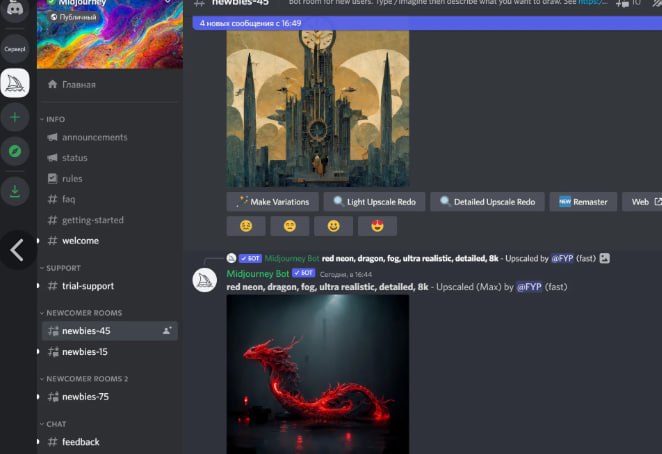
And the first Midjourney, where people had six fingers and besides the prompt, you had to set a bunch of parameters:
And here's the first animation model, Stable Diffusion Video. A regular creator without production experience would hardly be able to figure out how to give it a task to create a three-second video:
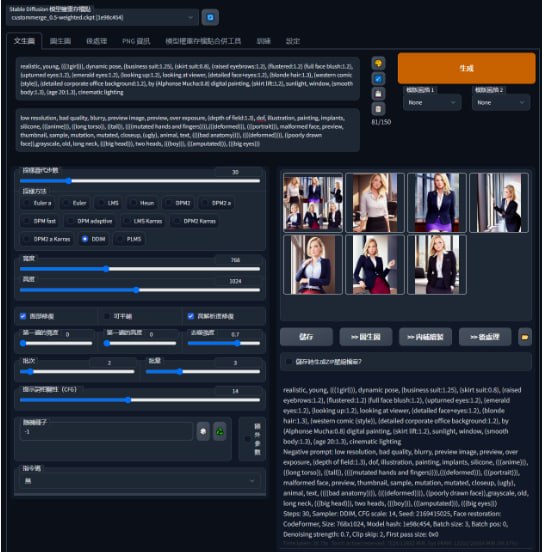
But the more suffering these models caused content creators, the faster the first systems began to appear that combined several models into a single interface. Essentially, this is how the idea of the modern AI aggregator was born.
To put it simply, what does an aggregator mean? It's a platform that brings together different tools in one place and allows you to work with them as a single system.
>>> Here's an overview of the three most advanced neural network aggregators for 2026 <<<
Today, a good online aggregator can no longer be just text-based or just graphics-based. The market has moved far beyond that. A modern neural network aggregator must be able to:
— write texts;
— generate images;
— create AI videos;
— produce voiceovers;
— work with avatars;
— use different AI models;
— perform editing;
— help with project management.
Essentially, a good neural network aggregator becomes a content creator's digital workspace. Interestingly, against the backdrop of the growing AI industry, this model is starting to win. According to several studies, the cause of burnout is increasingly linked not to the amount of work, but to the lack of convenient infrastructure around it.
Today, developers are competing not so much on generation quality, but on reducing the number of steps between an idea and finished content. Because if you need to open ten services to publish one video — that's not automation, that's just a new form of bureaucracy.
How the Syntx Aggregator Came to Be and Why Many Content Creators Are Switching to It
It was precisely from this problem that the idea of Syntx grew. If you look at most modern AI tools, they still solve individual tasks. One service helps write text. Another allows you to create AI video. A third makes images. A fourth handles voiceovers.
The creators of Syntx took a different path. They started building a system around the real working day of a content creator. Essentially, Syntx is an online aggregator that combines most of the tasks that content specialists face daily into a single account.
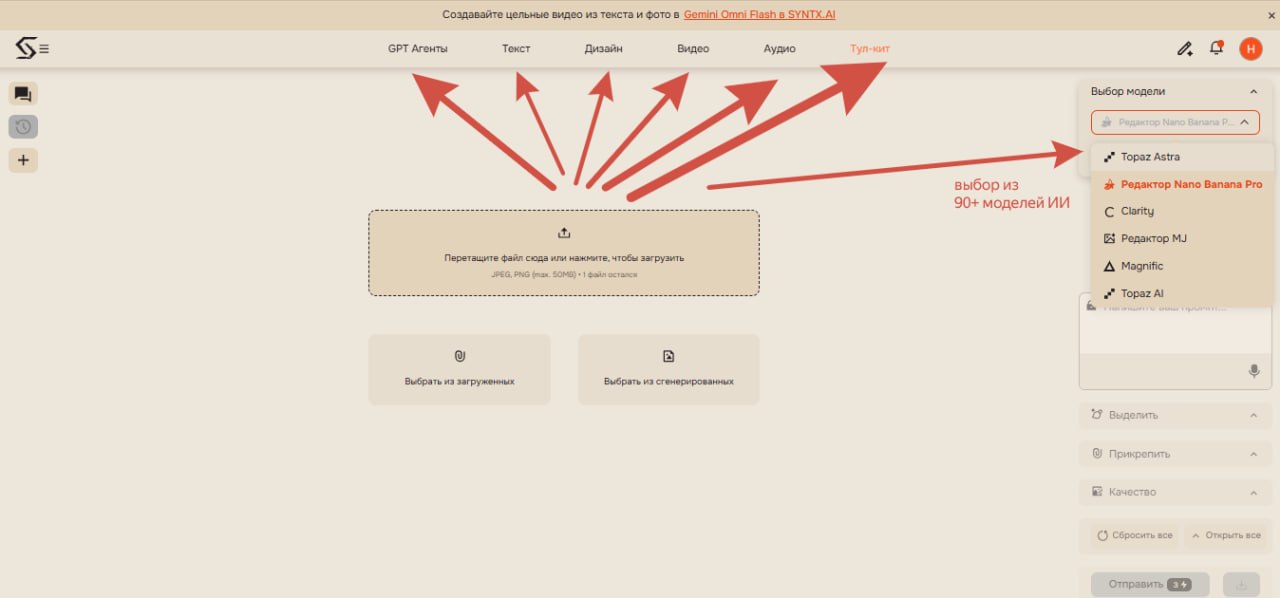
Here you can communicate with your own AI agents, create texts, images, ad creatives, videos with AI, connect voiceover tools with different voices, work in toolkit mode with individual tasks. For each task, you can choose the AI model that's convenient and familiar to you. What's important and great — during work, you won't be jumping between services, but simply switching tabs from stage to stage.
But that's not all. Some work on laptops, others create creatives on smartphones. So it's especially convenient that the platform works in two formats at once:
-
There's a full-fledged web version for working on a laptop, when you need to assemble large projects, manage content, and work comfortably with visuals,
-
And there's an AI Telegram bot, which essentially allows you to continue working on the go. Many specialists today work between meetings, on trips, and during business travel. The ability to quickly generate text, an image, or finalize a project directly from Telegram often turns out to be more important than it seems at first glance.
Everything works through one account and one subscription. This is especially relevant for the Russian AI market, where users regularly face restrictions from foreign services and payment difficulties. In the case of Syntx, access is paid with Russian cards, and the user gets a unified space instead of a collection of scattered subscriptions.
How Much Does Syntx Cost?
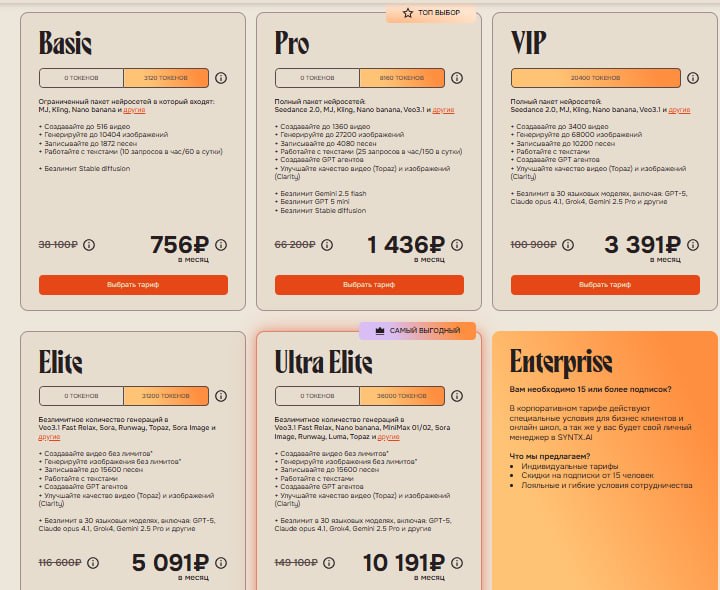
Another surprising thing. Syntx can be used without overpaying, at the same prices as the individual neural networks you would buy separately. So it's quite reasonable — from 756 RUB/month to unlimited for 10,000 RUB/month.
There are quite a few tariff plans, so you'll definitely be able to choose one that fits your needs. And at the end of the article, grab a promo code for a 15% discount if you register through the web version link.
And perhaps the best way to get rid of burnout today isn't to work even more or look for another miracle neural network. Sometimes it's enough to remove ten unnecessary tools from your life and replace them with one system that finally allows you to focus on the content itself. And that's no longer about technology — it's about bringing back the joy of work.
_____________________________________________
Promo code for 15% discount: PAYBACK
The links also give a 15% discount and free starter generations.