


How to earn your first 50,000 rubles on AI cards for marketplaces
Marketplaces have long turned into a separate universe with their own rules. Every day, thousands of new products appear on Ozon, Wildberries, and Yandex Market, but the buyer only sees their cards. It is these cards that decide whether a person will stop at the product or scroll further. You can sell an excellent product at a good price, but if the photos look like they were shot on a calculator in a dark hallway, there will be no sales. Therefore, sellers are constantly looking for specialists who know how to make cards look visually expensive, clear, and convincing.
Why creating product cards is a fast way to make money with AI
This is exactly where the story of how to make money with AI begins. Today, a designer no longer needs to draw every element manually or spend weeks studying complex graphics software. Modern services allow you to quickly prepare visuals, come up with a composition, improve product photos, select a design, and assemble a selling card in a matter of hours. But the neural network remains a tool. Decisions are still made by the human. Therefore, the market is ready to pay those who can combine taste, an understanding of marketplaces, and the capabilities of artificial intelligence.
Creating product cards for marketplaces remains one of the fastest ways to make your first serious money through AI today. There are real clients here, a clear service, and constant demand. You do not need to gather a million followers or wait for your own project to take off. It is enough to learn how to make cards better than the market average.
How much designers earn and on which platforms
When people look at the marketplace card market for the first time, they often imagine small orders for a few hundred rubles. But the reality looks more interesting.
Freelance exchanges
Even a superficial analysis of Kwork shows dozens of specialists who consistently sell services for creating cards for Ozon and Wildberries. A simple card consisting of one to three images usually costs from 500 to 1,500 rubles.
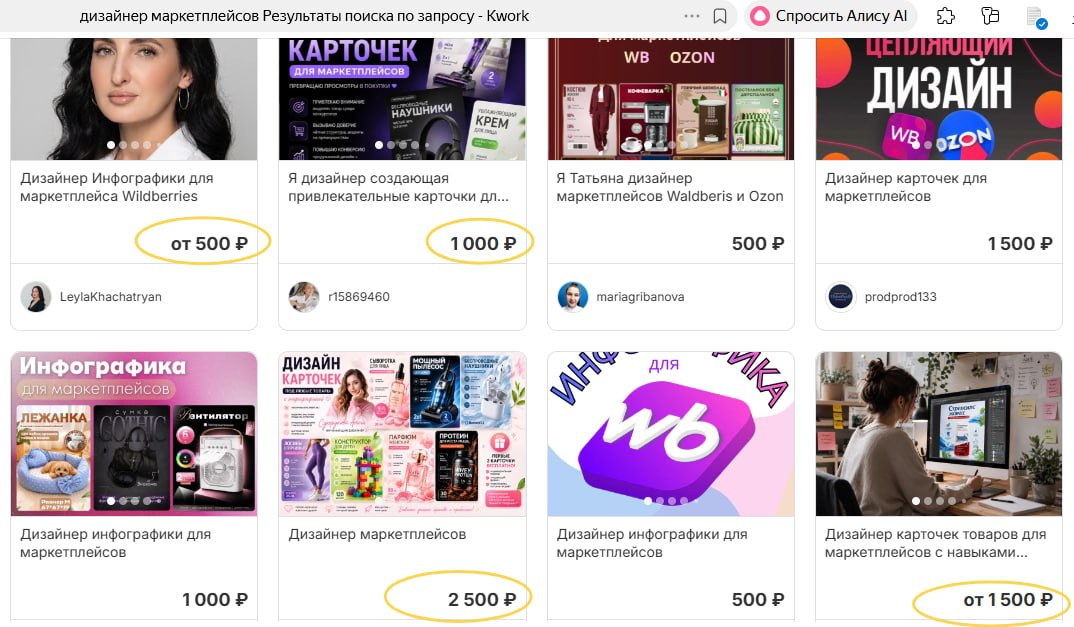
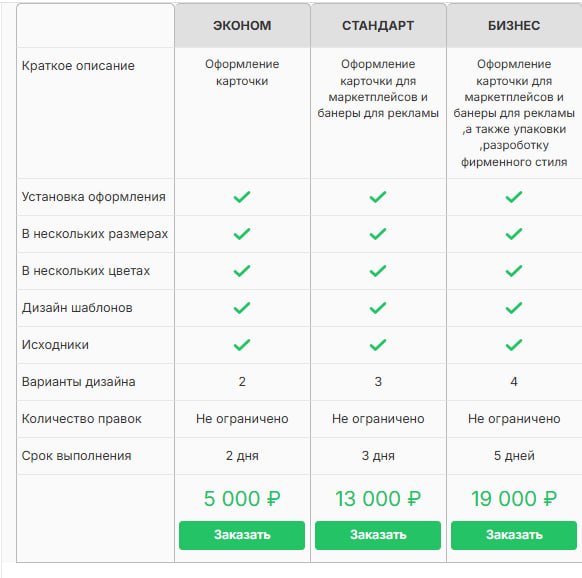
If we are talking about a full-fledged series of slides with infographics and a photo sequence, in several design options, the price tag easily rises to 5,000 rubles. And with promotional banners in addition to the cards, some ask up to 19,000 rubles. These are real rates from one designer on Kwork. A designer with a good rating means there are definitely clients for this.
On exchanges like FL.ru, Freelance.ru, Freelancehunt, and in Telegram communities, the situation looks even more interesting. Here, clients more often work with large volumes and are willing to pay for quality. The cost of a single card can reach up to 3,000–5,000 rubles. With a good portfolio, designers easily take on several such orders per month.
Avito
Avito remains a more budget-friendly platform. Beginner sellers often look for executors here, so average checks are lower. But it is Avito that allows you to quickly gather your first case studies and start receiving regular orders. The cost of a single card is usually in the range of 300 to 1,000 rubles, and a package of several images brings in 3,000–7,000 rubles.
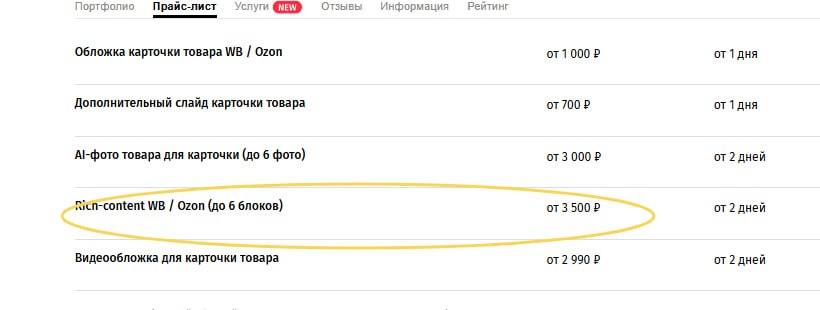
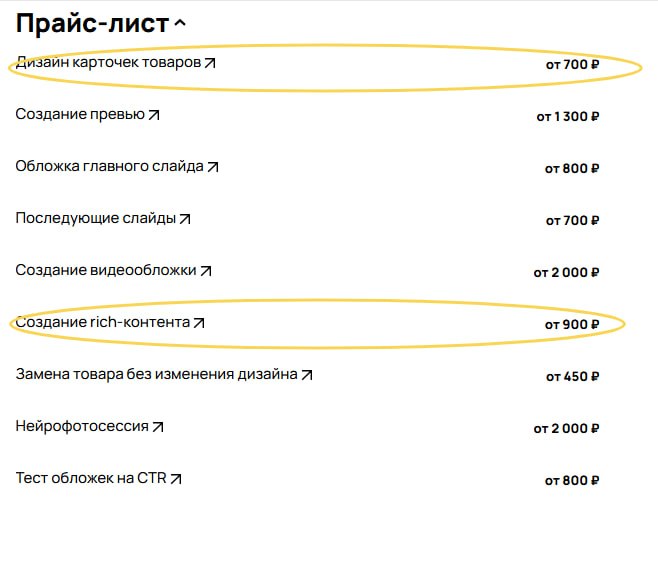
To make the comparison fair, let's look at the average prices of freelancers from Avito for the same card design and rich content services: compared to 1,500/3,500 rubles on FL.ru, here it is 700/900 rubles. Such prices are comfortable for beginners, and besides, small clients will come to this price tag faster than big ones will come to an expensive price tag.
Social networks and own website
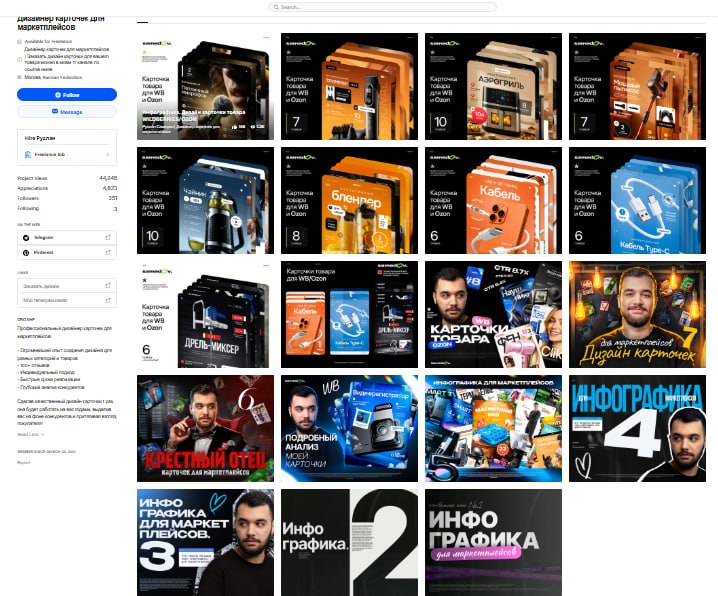
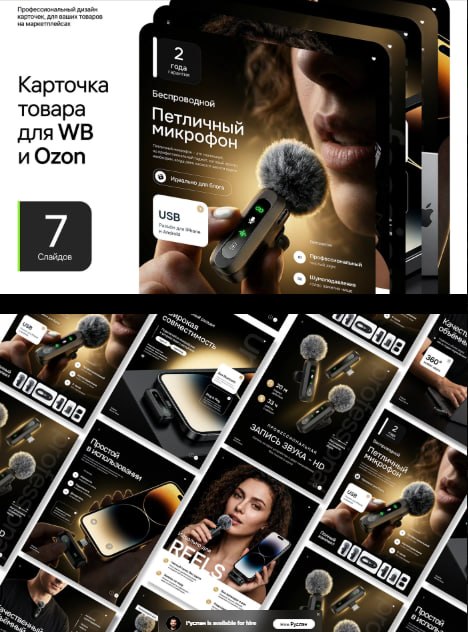
A separate category is Telegram, Instagram, and designers' own websites. That is where the most demanding clients and the highest budgets are found. A single project can cost as much as several weeks of work on an exchange. For a high-quality product card, they are willing to pay from 2,000 to 10,000 rubles here, and comprehensive design for a product line often costs tens of thousands of rubles. For example, this is what the website of a designer who doesn't take less than 10,000 rubles for a turnkey card might look like:
Summary table of prices for designer services
|
Platform |
Price per card |
Package of 5–10 photos |
Large volumes |
|
Kwork |
300–1,500 ₽ |
3,000–7,000 ₽ |
7,000–10,000 ₽ |
|
FL.ru and freelance exchanges |
1,000–5,000 ₽ |
5,000–15,000 ₽ |
10,000–20,000 ₽ |
|
Avito |
300–1,000 ₽ |
2,000–7,000 ₽ |
7,000–10,000 ₽ |
|
Telegram, Instagram |
2,000–10,000 ₽ |
10,000–30,000 ₽ |
from 30,000 ₽ |
If you translate these figures into monthly income, the picture becomes even clearer. To reach 50,000 rubles, it is enough to close 10–15 orders of 3,000–5,000 rubles or a few larger projects each month. For the marketplace market, these are completely achievable volumes.
How to make money on neural networks: a step-by-step plan to reach an income of 50,000 rubles
Now let's break this story down into simple math.
Stage 1. Let's assume you start working through Avito or Kwork and charge 300–500 rubles per single card. An order for ten cards already brings in 3,000–5,000 rubles. Ten such orders (100 cards) a month yield a turnover of 30,000–50,000 rubles. And this is without complex monetization schemes, without advertising, and without launching your own product.
Stage 2. Next, the cumulative effect begins to work. After the first completed projects, a portfolio, reviews, and self-confidence appear. Along with this, the cost of work grows, and you are already entitled to raise prices to 1,000 rubles per card. Then fifty cards a month (half the volume of work) already yield about 50,000 rubles in revenue. For experienced specialists, such volumes are considered quite workable.
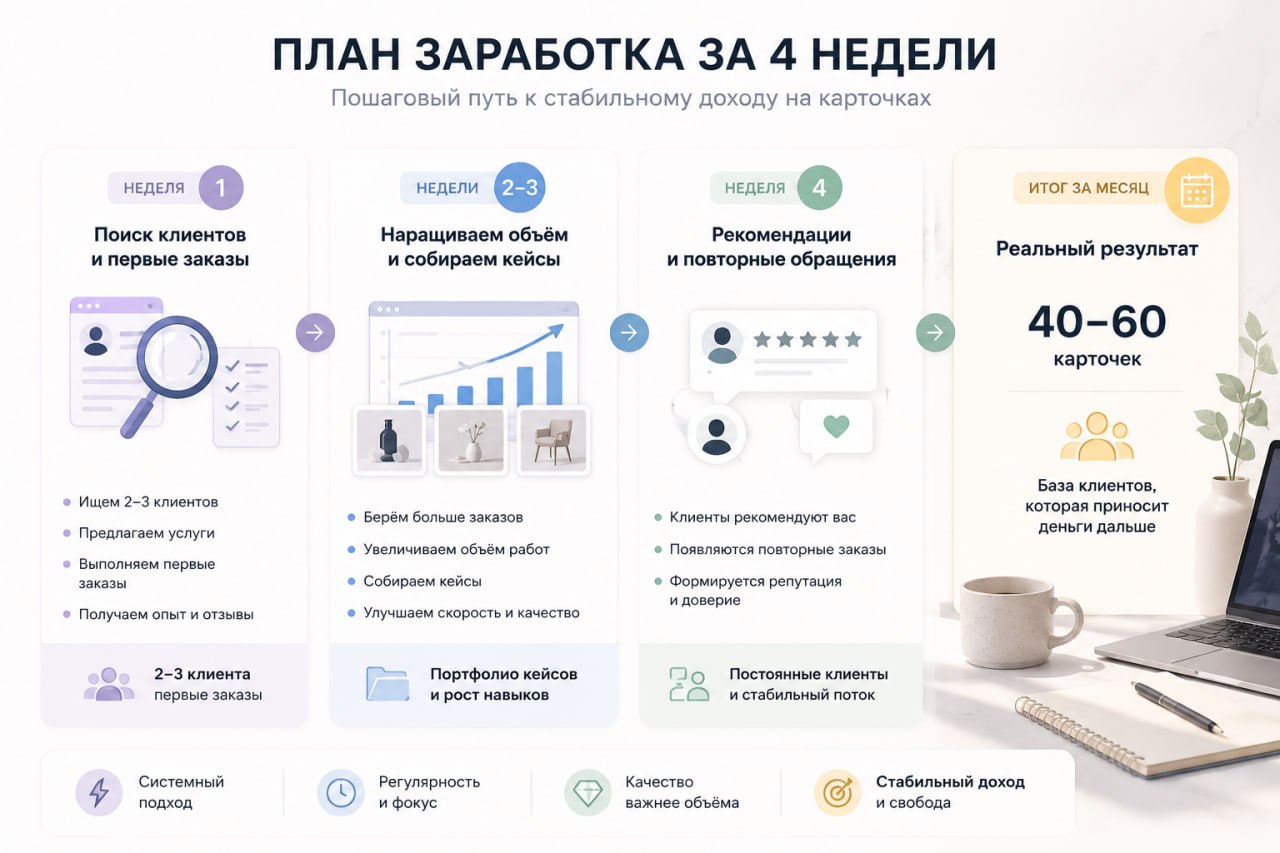
If you break down the path by weeks, it looks quite realistic:
-
The first week is spent searching for two to three clients and completing the first orders.
-
The second and third weeks allow you to increase the volume of work and collect case studies.
-
By the fourth week, recommendations and repeat requests already appear.
-
Within a month, it is quite realistic to make 40–60 cards and build a client base that will continue to bring in money.
The most interesting part of this model is that income growth depends not so much on the quantity of work, but on the quality of the portfolio. One strong case study can raise the cost of services faster than dozens of cheap orders.
How to find clients for creating product cards and scale earnings with AI
Finding clients looks much simpler than it seems from the outside. Marketplaces themselves become a huge database of potential customers. It is enough to open any product category and look closely at the cards. Very quickly, poor-quality photos, overloaded infographics, strange colors, a lack of a unified style, and visual chaos begin to stand out.
At this moment, a reason for dialogue appears. Instead of a templated offer of services, it is much more effective to show that you have already spotted a specific problem. Such a message looks like an attempt to help, rather than just another newsletter spam.
For example:
“I noticed the cards for your product. Several images look overloaded, and the benefits of the product get lost against the background of a large amount of text. I have a few ideas on how to make the visuals more selling.”
After the first contact, you can offer a free mini-review of the cards. It is enough to point out 2–3 weak spots and show how they affect the perception of the product. Then offer a test design of one or two cards. This approach significantly reduces client resistance and helps you get your first order faster.
During negotiations, the emphasis should not be on a low price. Sellers are not interested in saving money for the sake of saving money. They are interested in sales. Therefore, the argument that a new card will help better display the product, increase click-through rates, and improve conversion works much better.
How to create a designer portfolio that attracts high-paying clients
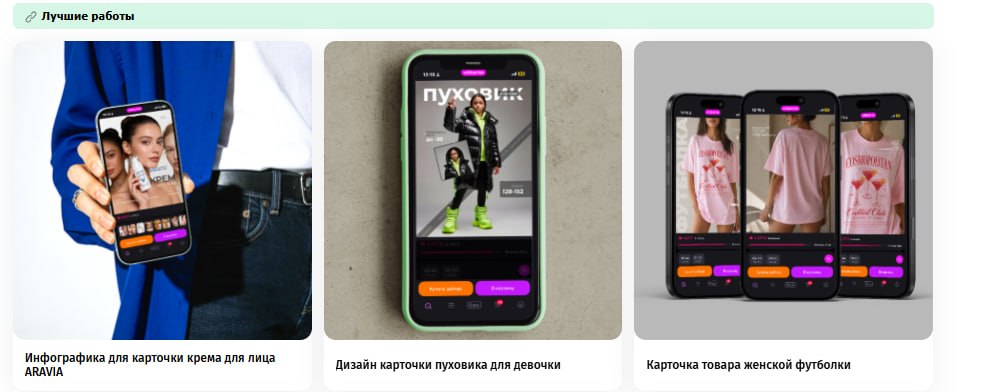
A good portfolio today resembles an expensive store window. If it looks convincing, the question of price recedes into the background. Therefore, it is worth including several different types of cards in your portfolio: a main image, infographics, a photo sequence, and examples of rich content. It is advisable to show different categories of goods so that the client sees the flexibility of your solutions. Here is a clear example of a designer portfolio from Fl.ru:
One of the most powerful formats is "before/after" projects. In such examples, the difference between a regular card and professional design becomes obvious even to a person without design experience. Find a poorly formatted card from the seller you are writing to. Change something you consider necessary on one slide, and send them a clear example of how you propose to fix their specific presentation. Be sure to include a comment: why it was bad, what you changed, and why it should be better now (color correction, additional details, words, arrangement of elements, etc.). It is these case studies that most often bring in new clients.
It is interesting that in 2026, it has become much easier for beginner specialists to build a portfolio. While previously one had to spend weeks studying composition, retouching, and commercial photography, today specialized AI services help perform part of the work.
Aidentika: Russian-language AI for photos that helps beautifully generate selling cards
This is exactly where Aidentika comes in. Many beginner designers look at the cards of major brands much like a teenager looks at a sports car through a dealership window. Beautiful. Impressive. But it is unclear how to replicate such a result on your own.
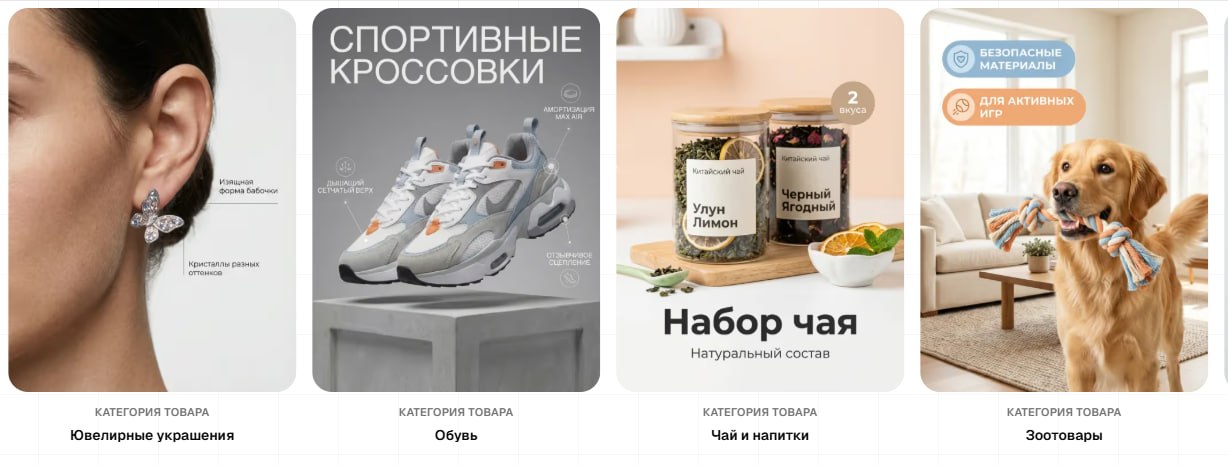
In this regard, Aidentika works like an experienced art director sitting next to you and suggesting solutions. The service helps use AI for photos, analyzes visuals, and offers options for improving cards. Through it, you can generate a person for an advertising scene, get a description using a neural network, figure out the composition of infographics, and understand why some cards look expensive while others resemble flea market listings.
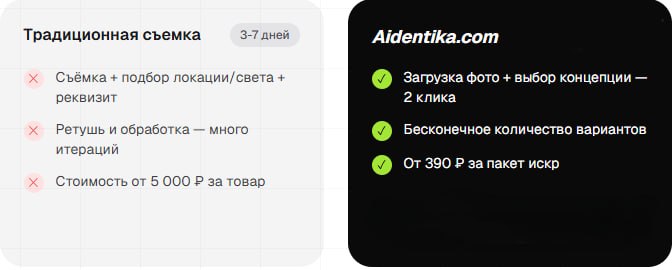
It is especially convenient that the service works as a Russian-language AI, so you do not have to translate queries and figure out complex English instructions. If the task is to beautifully generate an advertising scene or improve a product photo, the system literally breaks down the solution step by step.
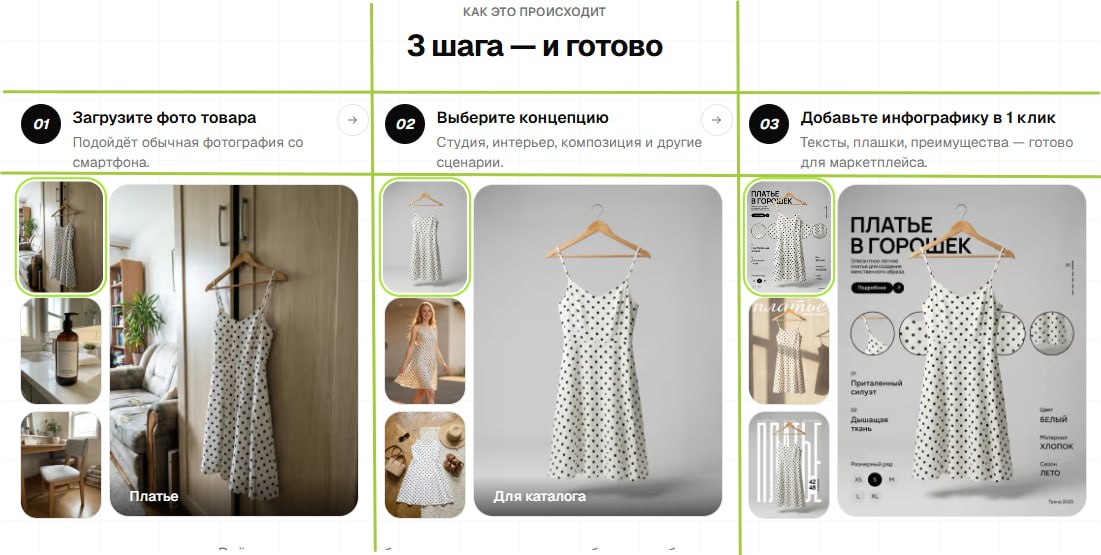
As a result, the designer gets not only the finished visual but also an understanding of how to create such cards on their own in the future.
How to make money on neural networks in 2026: the final strategy for reaching your first 50,000 rubles
The marketplace market continues to grow, and with it grows the demand for specialists who know how to make high-quality product cards. For sellers, the card remains the main sales tool. That is why the work of creating it is consistently in demand and well paid.
If you look at the numbers, it becomes clear that an income of 50,000 rubles is much closer than it seems. A few orders a week can yield such a result right at the start. After a portfolio and the first reviews appear, the cost of services begins to grow, and along with it, the monthly income grows too.
Clients can be found on Kwork, Avito, freelance exchanges, on Telegram, and in social networks. A simple scheme works: find weak cards, point out the problems, and offer specific solutions. This approach helps to stand out even without much experience.
A portfolio can be assembled on your own using examples of existing products. A few strong case studies often work better than any advertisements. And if you want to quickly figure out visuals and understand which neural networks modern designers make money on, you should pay attention to the cool new Aidentika service. This is a real help to quickly get acclimated to the market and understand how you can make money on neural networks using real commercial tasks.
Creating product cards for marketplaces remains one of the clearest ways to make money on neural networks without any warm-ups and funnels. There is real money here, real clients, and a clear path of growth.